Ready, Fire, Aim: Three decades of prototypes (and counting)
Follow your true north; screw market research. If you love it, the right people will also love it. Haters are not your fans, don't try to convert them. Focus: If you want it to exist, just start!

1990-92. Van Nuys CA. I was a trainee draftsman at a (short lived) start-up aircraft upgrade firm called Galaxy Group that was headed up by Mercury astronought Col. Gordon Cooper. At Galaxy Group I was trained by senior engineers; many of whom designed WW2 aircraft that were integral in the war effort. They allowed me to come in after hours to work on my own my own project. By day I was drawing aircraft parts and by night I was rendering full scale drawings of my dream instrument: a modern take on a 19th century guitar-violincello called the "Arpeggione" by Johann Stauffer. I had no Idea what the original looked like but I knew what I was after! I read about the Arpeggione in 1989 while I was voraciously reading an entire 1948 encyclopedia volume about violins. (We did not have Google back then and library books generally came up empty). I took my best shot. Eventually something sort of like it (but prettier) came to be after a collaboration with a more experienced Latvian luthier who came to the USA after the Berlin wall came down. I played it through the 90's (though I distanced myself from said builder who I had complicated relations with). As such, I completely soured off of the idea of starting a guitar company at all. Nope, not for me! After a decade of frustration, I returned to sketching new designs by Y2K.
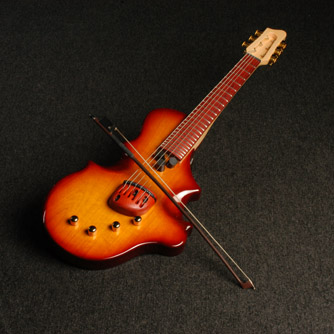
From November 1999 to January 2008, I was the assistant manager of Cassells Music (for those of you who remember the "No Stairway" scene in Wayne's World). During the early years, at Cassells, I designed a humidity controlled Acoustic guitar room and developed what can be described as a hot rod take on an otherwise rustic Tex-Mex baritone 10 string guitar called a Bajo Quinto (12 string versions are called Bajo Sextos). These curiosities are typically played in a Mexican Polka style music called Norteno and some forms of Tejano. At the time, newer versions of the Arpeggione were still back shelved. On the other hand, I was into looping ambient sonic landscapes with the early 90's prototype and had an artist page (dial up days) and even appeared in a Guitar Blog of the day. One day I had an "aha" moment when setting up a viola in the store. Since I can not play under the chin violin style to save my life, I played it in my familiar guitar/cello in the lap/Viola Da Gamba style. Voila! (Or Viola, literally). I could actually play viola this way and the shorter scale was quite comfortable! I was struggling on my 25.5" scale Arpeggione and hurting myself for a decade. What would a shorter scale be like if it was somewhere between the 25.5" Guitar and the 16" Viola? Hmmmm.....
Having learned (the hard way) that what checks out (looks good) on an engineering drafting board does not mean it will be comfortable in real life! I had seen builders like Steve Klein make "ergonomics first" designs that were hard on the eyes but super comfortable for serious playing. Before anything went to templates, I sculpted Styrofoam mock-ups (sketching in 3-D if you will). I arrived at a design that stabilized the instrument on the left leg and optimized my preferred bow approach. (Remember folks, I really was designing something for my own requirements and this was not meant for the market!). The scale I arrived at was completely by feel. I rounded it off to 21" which is somewhere between 16" Viola and 25.5" Guitar. (Actually, the literal average is 20.75 but I like 21 as a number divisible by 7. I'm kooky that way. However, it worked for my own comfort goals and has been the spec of all GuitarViol builds. I have played in comfort ever since and that burning/numbing in the back/shoulders/hands went away! Now, I am seeing copy-cats of my instruments pop up (around the world) with no deep understanding of what they are building. It is like trying to copy HTML code to copy facebook. It won't work because only facebook understands facebook and the copied code will be obsolete by the next day. Though I have stuck with the basic constraints and caveats of my instrument over the years, I have applied some "Kaizen" (Japanese for continuous improvement and change). The mission remains the same even though there is deliberate evolution in the laboratory.
For the record, I had no real intentions of becoming a serial builder; let alone a factory operator. In fact, what I knew about the guitar business I did not like. (Being an industry insider for close to 30 years, I know the thin margins and crap mass producers go through). My aim was to have my own instrument and perhaps a career playing live on the fly improvisational looping music. I had no ambitions of being a stressed out business operator and I know how delegation resistant some things are. (Yes, delegation backfires). I had worked in retail music stores (big and small) and had a decent operating knowledge of business basics (though I am no great leader of people, not Moses). On the other hand, I do have a precise artistic vision for the flavor and aesthetics an enterprise on my terms would be. It seems many are baffled by the fact that "scaling up" to become some sort of "big deal" manufacturer is not my motivation. I know people at the top of respected guitar manufacturing companies and though I respect them, I do not envy them. It is like having a Dog: The bigger the dog, the bigger the yard, the more you have to feed it, the more crap you have to pick up and the smaller snarkier dogs actually live longer. Yes, I am an artist who is a front man to a metaphorical "tiny dog" enterprise that allows me pivot on things without layers of corporate bureaucracy. I like it that way. "More, bigger, faster, cheaper" is not where I live (though I am often chided for not being some type of scaled up manufacturing mogul peddling consumer goods. Always open to the right arrangement though). Still an anxious ADHD artist trapped inside of a wild bronco business operation applying uncomfortable & unnatural discipline. Not for the faint of heart.
The struggle of perfection, focus; prototypes or individual works of art? All of that and more! When I made the first TogaMan prototype in 2002, it wound up being repeated for the first 8 years. #1 I had a very definite vision and not much was changed. What happened was that demand escalated, things were tooled up. Going down major re-engineering/redesign rabbit holes were at direct odds with delivering instruments and a growing build queue of people annoyed that they have to wait at all. (I know, that's a good problem many dream of!) Overnight, not having a ready supply of fully developed instruments became frustrating to those wanting one. These instruments were never "ready for prime time" but "prime time" slurped them up ready or not! They became a victim of their own success! i.e. they were (still are) in continuous development. It can be said that the film/TV soundtrack industry of the last two decades was flavored with no less than 350 prototypes at various stages of evolution. Hundreds of composers all over the world and probably thousands of soundtrack ques feature what represents a continuous crowd fund. It is a loop of an ever present dilemma: Can I take a swan dive into a major creative engineering project without killing the monthly cashflow loop of production and deliveries? The state of Flow (being on a roll) that creative engineering requires is at direct odds with the daily minutia of business; the latter being a stressful distraction! Even budgeting time itself is destructive to the process because abruptly disengaging from creative flow for the legitimate distractions that come with business admin is far more profound than most folks can fathom. (constant fits and starts). "Flow" is not something that likes rigid schedules! When flow happens, you have to surf it and time does not exist! So, it is a constant struggle of focused laboratory time (flow) vs the consuming fire of keeping the overhead paid on time. In an ideal scenario, I would love to take several weeks/months to really dig in to the Lab! However, the tyranny of the production routine keeps it into a riptide holding loop of "deliver or else". (So, I am looking to fund the ever strained lab time.)

The takeaway: Striving for perfection in the short term will not ship nor keep the lights on. Building the plane as it flies may not make sense but may be exactly how it will happen or not. (Ready, fire, aim). Sometimes your demos are the masters if they are all you have that day! When I was building the first TogaMan prototype, I had no shop full of tools! I had a chunk of Alder, a rusty bastard file, blistered hands in an unairconditioned San Fernando garage during triple digit summer days, and a dream. (Just start and fail forward). The next one will always be better and the tools will gather. If we get trapped in the OCD holding loop, or having the right XYZ nothing will happen. McGyver it from nothing at first and improve the equipment and process along the way. If you don't like it, destroy the evidence and make another one. Don't get too attached or eternally polish a turd like it's gold - destroy it. Start your next sketch and hours/days later you may just have a masterpiece! Just start. Oh, forget what others think. Steve Jobs was not asking the market about smart phones and Henry Ford said the public wanted faster horses. Follow your true north; screw market research. If you love it, the right people will also love it. Haters are not your fans, don't try to convert them. Focus: If you want it to exist, just start!
If you are curious about learning more, check out these links:
TogaMan GuitarViols (Main site)
If you are interested in the GuitarViol, or interested in supporting the R&D laboratory through gifting your favorite musician with one, do reach out!


Comments
Post a Comment